Active Hospitals help deliver the NHS 10-Year Plan by putting movement into care
Beth Sutcliffe looks at the contribution to local, regional, and national strategies that the Active Hospital scheme offers.

Share
It was great to be able to attend Manchester University NHS Foundation Trust’s (MFT) recent Active Hospitals launch and hear their commitment to supporting staff and patients to move more.
We have seen the number of Active GP Practices in Greater Manchester more than double in the past two years making positive changes to boost staff and patient wellbeing through physical activity and movement.
There’s great potential for hospitals to help create the conditions for active lives at scale.
MFT, for example, have ten hospitals with 30,000 staff and serve a population of around a million people. This is a huge opportunity to support those who can benefit the most from moving a bit more.
Although half of patients experience a functional decline between hospital admission and discharge, the message from the launch was loud and clear: deconditioning can be prevented.
The stats on deconditioning are powerful; patients spend up to 83% of their time in bed while 60% have no documented reason to explain why they are on bed rest.
40% of muscle strength can be lost during the first week of hospital admission with deconditioning causing delays in getting people home in nearly half of older patients.
We know from our work across Greater Manchester Moving that there is no single programme or project that can tackle the inactivity crisis we face as a nation.
Culture and social norms are at the top of this socio-economic model which guides our whole-system approach and it was great to see this really come through last week. See MFT slide below.
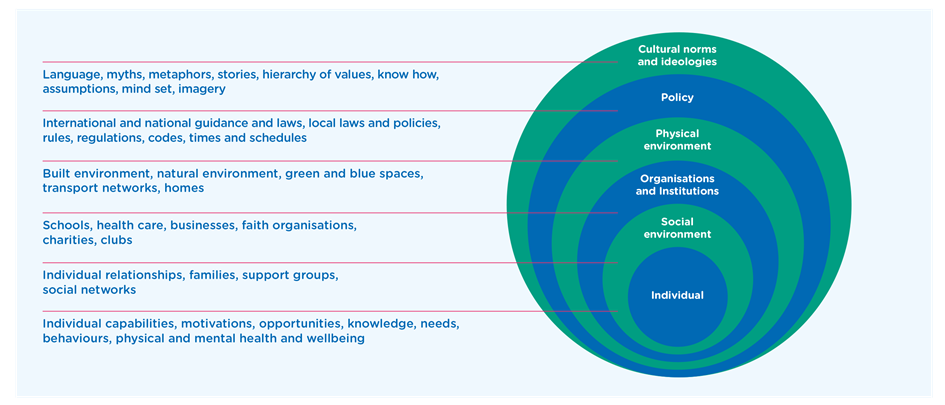
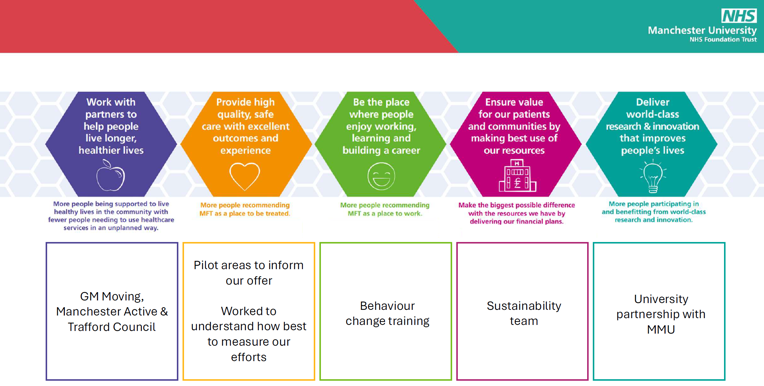
Examples of how MFT are already shifting culture were shared such as the ‘Rise and Shine’ initiative which supports staff to identify and support patients who are able to get up and out of bed, to move more.
A shift in culture requires little to no extra resource. Culture, mindsets, and behaviours can be changed with minor tweaks.
There is a commitment to create a positive culture of physical activity at MFT with senior advocates energetic and dedicated to the change they want to see.
They know they need everyone to play their role, and I saw a clear call to action for those who attended to be champions and take back this culture to their wards.
The strategic leadership is enabling collective leadership which is one of our five enablers of change which research and experience shows is needed for progress to be made.
Active Hospitals will help us all deliver on the NHS 10-Year Plan unveiled by government earlier this year which has a focus on prevention and embedding movement into care.
Our role at GM Moving is to continue to shine a light on examples like this to help show other hospital trusts what's possible.
Additionally, we are helping to deliver Physical Activity Clinical Champions Training to help staff have more effective conversations about physical activity with their patients.
So, congratulations to all at MFT on their commitment to Active Hospitals, we look forward to working with them and others in supporting all patients to live well.
Remind yourself of CEO Hayley Lever’s blog on Active Hospitals from 2019 here.
Latest News

Empower Her: Lessons from a place-based approach to widening access to football
The 'Empower Her' fund supports inclusive football sessions, leadership pathways, and stronger local partnerships.

National recognition for Prehab4Cancer as it launches education initiative for leisure centre staff
Experience, education and data garnered by the pioneering Prehab4Cancer (P4C) programme in Greater Manchester has helped to shape national guidelines on cancer care adopted by the NHS and Macmillan Cancer Support.

Race Equality Week 2026: Why change needs all of us
By understanding cultural norms, feelings of belonging, and how safe people feel in a space, we can make physical activity more inclusive for everyone.